+39 376 020 6581 Mon-Fri 09-18


+39 376 020 6581 Mon-Fri 09-18
When choosing tiles with which to decorate a room we have to keep several factors in mind. Not only colour, material, style, size and thickness, but also the different types of border.
In particular, it is necessary to decide whether we prefer a tile with a rectified border or not, a choice that will depend on the type of room and will affect the different types of joints.
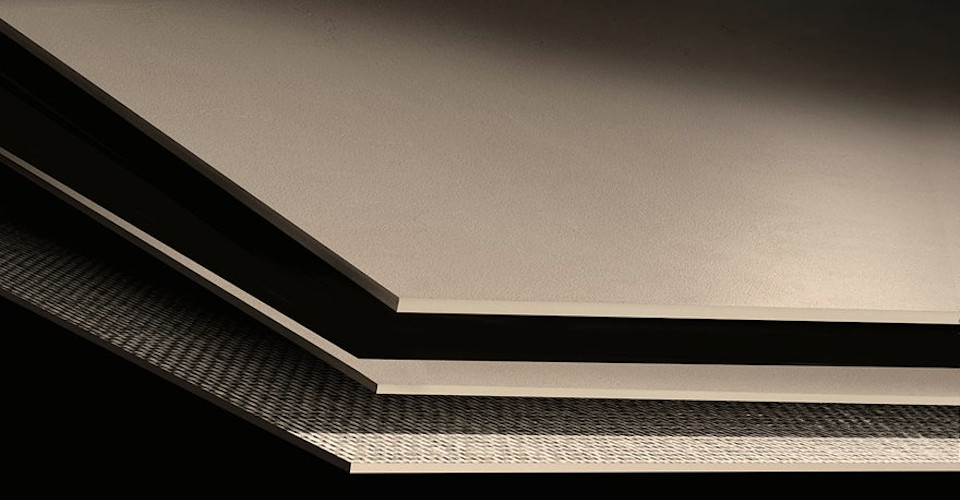
During the tile manufacturing process, ceramics are fired at high temperatures which can lead to a dimensional transformation. Each tile at the end of firing has a reduction of approximately 10 per cent compared to the initial size.
Due to this process, the tiles are not all the same but can have small differences. These are only a few tenths of a millimetre, but determine the non-homogeneity between one piece and another.
In order to make the tiles all the same size and one-size-fits-all, one therefore resorts to rectification, i.e. an operation to square the edges. Using specific machines, the tile edges are cut and made straight.
Rectified tiles are therefore nothing more than tiles that are all the same, with perpendicular edges and right angles.

Making a rectified porcelain stoneware floor can have a number of advantages, obviously always depending on the end result we want to achieve.
First of all, the fact that the edges of the tiles are homogeneous and square means that they can be laid with a minimum joint of 2 mm. In this way the surfaces will be more homogeneous, not only the floors but also the walls.
Clearly with a cement, marble or wood effect porcelain stoneware the final result will be better, because the joints between the tiles will be almost imperceptible.
A minimal joint also guarantees better hygiene. Cleaning a rectified floor is much easier, an aspect that should not be underestimated for rooms such as bathrooms and kitchens.

The choice between a rectified tile and one with natural edges depends first of all on the style we want to give the room.
An unrectified tile, therefore placed with wider joints, will certainly give a more traditional look. Reduced joints, on the other hand, will make the atmosphere more minimal and contemporary.
Furthermore, if we want to give the impression of a continuous surface, the choice of a rectified tile is obvious.
A cement effect porcelain stoneware floor will look much more authentic if rectified. The same is true for walls, in fact it is very trendy today to cover them with rectified stoneware tiles.
Then we must consider the type of room and the use to which it will be put. As already mentioned, rectified tiles are easier and quicker to clean precisely because of their more uniform surface type. The risk of moisture and dirt residue between the joints will be minimised.
Consequently, in bathrooms, kitchens, but also in medical practices and all other places where hygiene is particularly important, it is advisable to use this type of tile.
All prices displayed in EUR
and inc. VAT. Shipping costs, if any, provided separately.
Crossed-out prices indicate the Manufacturer's suggested retail price.